
Are you incompatible, or is avoidance sabotaging your relationship?
How Attachment Patterns, Protective Strategies, Or Values Mismatches Shape Our Decisions to Stay, Leave, or Keep Trying.
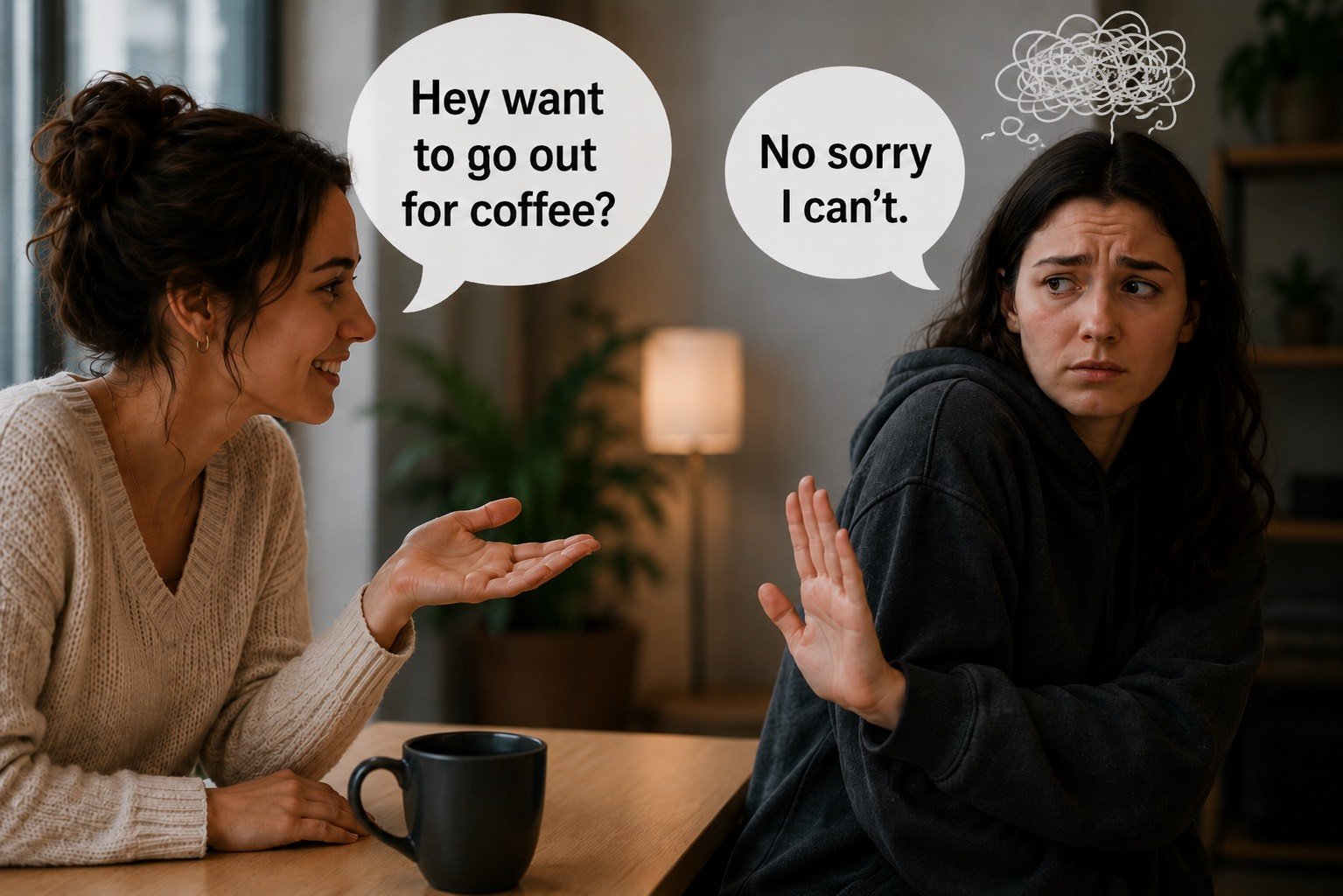
Imagine the possibilities that can unfold when we say “yes” to innocent bids for connection. Reflection Question: Was there a time when fear caused a tiny rupture or confusion that impacted the trajectory of your future interactions?
Deciding Whether to Stay or Leave
Are your values incompatible, or is avoidance sabotaging your relationship?
One of the most common questions clients bring into therapy is:
“Should I stay or leave this relationship?”
These questions arise when evaluating all types of relationships: colleagues, partners, friends, collaborators.
Sometimes the answer feels clear.
Often, it doesn’t.
Clients often find themselves wondering:
• Are we fundamentally incompatible?
• Is this a values mismatch?
• Is my partner emotionally unavailable?
• Are attachment patterns getting in the way?
• Is there a way to heal what’s happening between us, or is this relationship no longer healthy to invest in?
These questions are difficult because the behaviors we see on the surface don’t always reveal what’s happening underneath.
Sometimes repeated relational difficulties truly reflect a mismatch in values, and sometimes they’re rooted in attachment patterns or avoidance. Sometimes they’re influenced by neurodivergence, relational trauma, anxiety, life circumstances, or other protective strategies. And sometimes it’s a combination of several factors.
Challenges rooted in avoidance can have very different origins and motivations than genuine incompatibility. Sometimes avoidance shapes behaviors and thought patterns so convincingly that they feel completely real and justified to the person experiencing them.
Before deciding whether to stay or leave, it can be helpful to understand what role avoidance may be playing.
Because sometimes people simply haven’t been given enough authentic relational data to accurately know the person they’re trying to understand.
They’re left wondering:
“Is this someone whose behavior I simply don’t respect?”
“Are they okay hurting people or behaving unprofessionally?”
“Are they capable of gaining real, embodied, in person relational data?”
“Are they emotionally unavailable?”
“Is there actually a deeply routed other pathology at play here?”
“Are they just playing games with my mind? Do they actually mean what they say? Why is the narrative shifting every day?”
“Or are avoidance patterns sabotaging their ability to show up in the relationship?”
Figuring out the route cause of disconnection is challenging, so people naturally begin creating narratives to make sense of what they’re experiencing.
So what makes connection so difficult for some people to stay in?
Let’s first explore what avoidance is, what causes avoidance behaviors, how they sabotage relationships, and how to distinguish them from a genuine values mismatch.
⸻
What Is Avoidance?
Avoidance can encompass behavioral patterns, situational protective strategies, or deeply rooted attachment patterns.
There is an important difference between deeply rooted avoidant attachment and situational avoidance.
Deeply Rooted Avoidant Attachment
Deeply rooted avoidant attachment is often entrenched and tends to appear across different contexts and all types of relationships.
People with deeply rooted avoidant attachment often learned, through early relational and developmental experiences, that closeness was unsafe. Over time, those experiences shaped nervous system pathways that associate intimacy with danger rather than safety.
Many people with avoidant attachment genuinely desire love and connection, yet find themselves repeatedly pushing others away before intimacy develops.
Their thoughts and internal narratives become intertwined with their nervous system responses. When closeness increases, they may begin engaging in distancing or “deactivation” strategies such as:
• flaw finding
• deactivation strategies
• triangulation as reinforcement rather than accountability or direct conflict repair
• emotional withdrawal
These strategies are sometimes unconscious, happen quickly, and often emerge when intense feelings arise within relationships.
Some people experience significant anxiety, panic, dissociation, or emotional overwhelm as intimacy increases. Distancing strategies temporarily reduce that discomfort while reinforcing the belief that distance is necessary.
Unfortunately, many people with deeply rooted avoidant attachment delay seeking therapy and may initially attribute relationship difficulties primarily to the other person rather than recognizing how avoidance behaviors contribute to the relational cycle. They may also struggle to recognize how their avoidance impacts their partner.
⸻
Situational or Protective Avoidance
Not all avoidance reflects an avoidant attachment style.
Many clients develop protective avoidance after experiencing one or more painful relationships with an avoidant partner.
This can look like:
• Not texting back right away because you don’t want to appear “too eager.”
• Purposely staying single or turning down dates even though you crave connection.
• Acting cool, detached, or aloof while privately feeling anxious and longing for reassurance.
These behaviors often develop after relational trauma, where the core fear is abandonment rather than engulfment.
Sometimes people find themselves adopting some of the same distancing behaviors they experienced from a previous avoidant partner.
⸻
Other Causes Situational Avoidance?
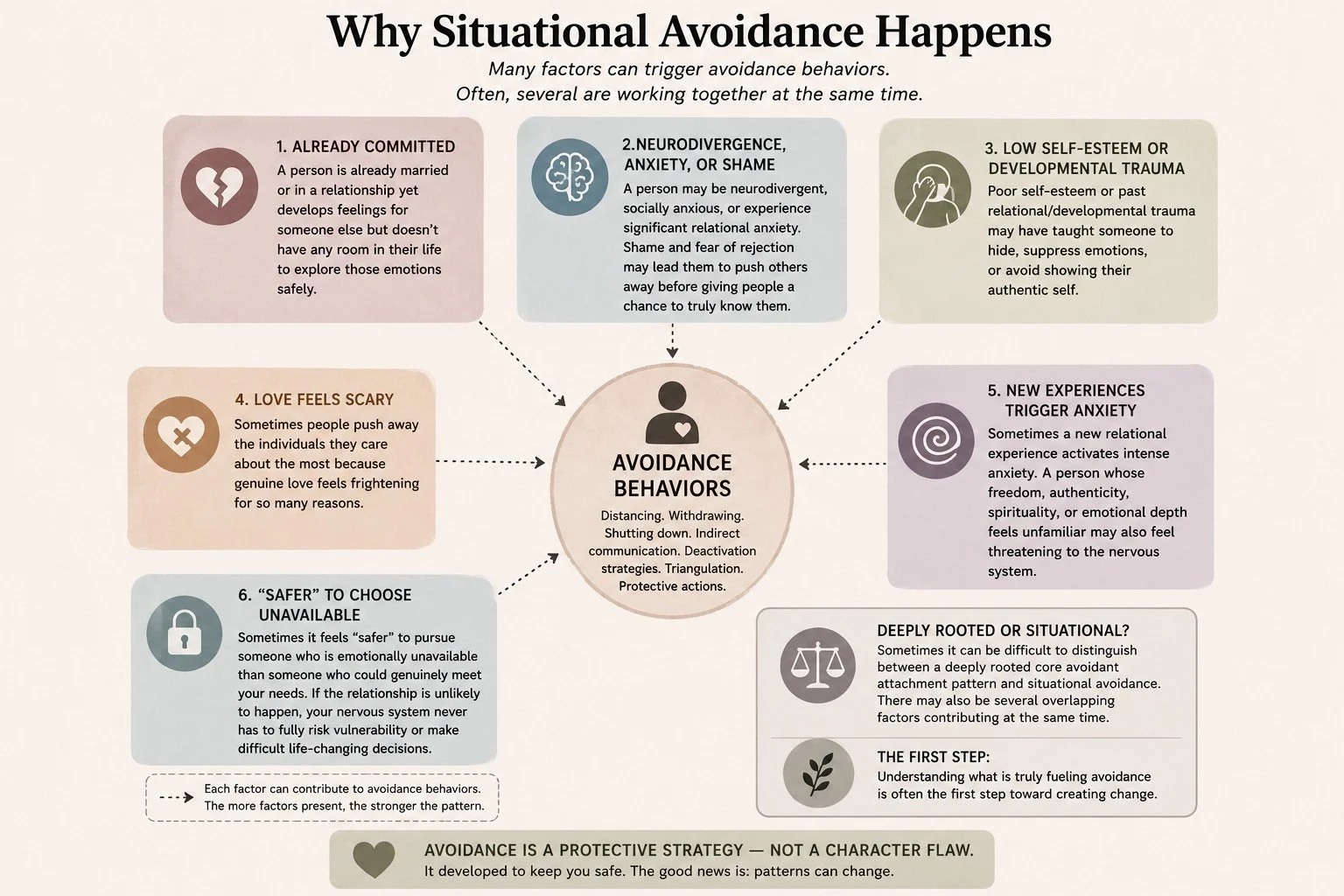
Note: For the best viewing experiences, view the images and diagrams in this article on a desktop or tablet where the details are easier to see.
Situational avoidance can develop for many different reasons, and identifying the true cause isn’t always straightforward.
For example:
• A person is already married or in a relationship yet develops feelings for someone else but feels there is no room in their life to explore those emotions safely.
• A person may be neurodivergent, socially anxious, or experience significant relational anxiety. Shame and fear of rejection may lead them to push people away before giving others the chance to truly know them.
• Poor self-esteem or developmental trauma may have taught someone to hide, suppress their emotions, or avoid showing their authentic self.
• Sometimes people push away the individuals they care about the most because genuine love feels frightening.
• Sometimes an entirely new relational experience activates intense anxiety. A person whose freedom, authenticity, spirituality, or emotional depth feels unfamiliar may also feel unexpectedly threatening to the nervous system.
• Sometimes it feels “safer” to pursue someone who is emotionally unavailable than someone who could genuinely meet your needs. If the relationship is unlikely to happen, your nervous system never has to fully risk vulnerability or make difficult life-changing decisions.
Sometimes it can be difficult to distinguish between a deeply rooted core avoidant attachment pattern and situational avoidance. There may also be several overlapping factors contributing at the same time.
Understanding what is truly fueling avoidance is often the first step.
Working with a skilled therapist in Philadelphia who specializes in attachment complexity and trauma can help clarify these patterns and create a more accurate treatment plan.
Regardless of the underlying cause, avoidance behaviors can create significant damage within relationships.
⸻
How Avoidance Lies to You
Avoidance doesn’t just influence behavior. It influences perception.
Avoidance has a powerful grip on both the nervous system and the internal narratives we create.
Avoidance can cause you to make choices under emotional pressure that you otherwise wouldn’t make.
Avoidance can trigger others to respond in ways they normally wouldn’t, bringing out insecurities, protest, or urgency in people who are otherwise secure or “chill” in most contexts.
Avoidance can lead you to hurt people without realizing or coming to terms there were other choices available.
Most importantly, avoidance makes turning toward connection incredibly difficult.
Even after small moments of growth and repair, your nervous system may sound an internal alarm that says:
“Stop right here.”
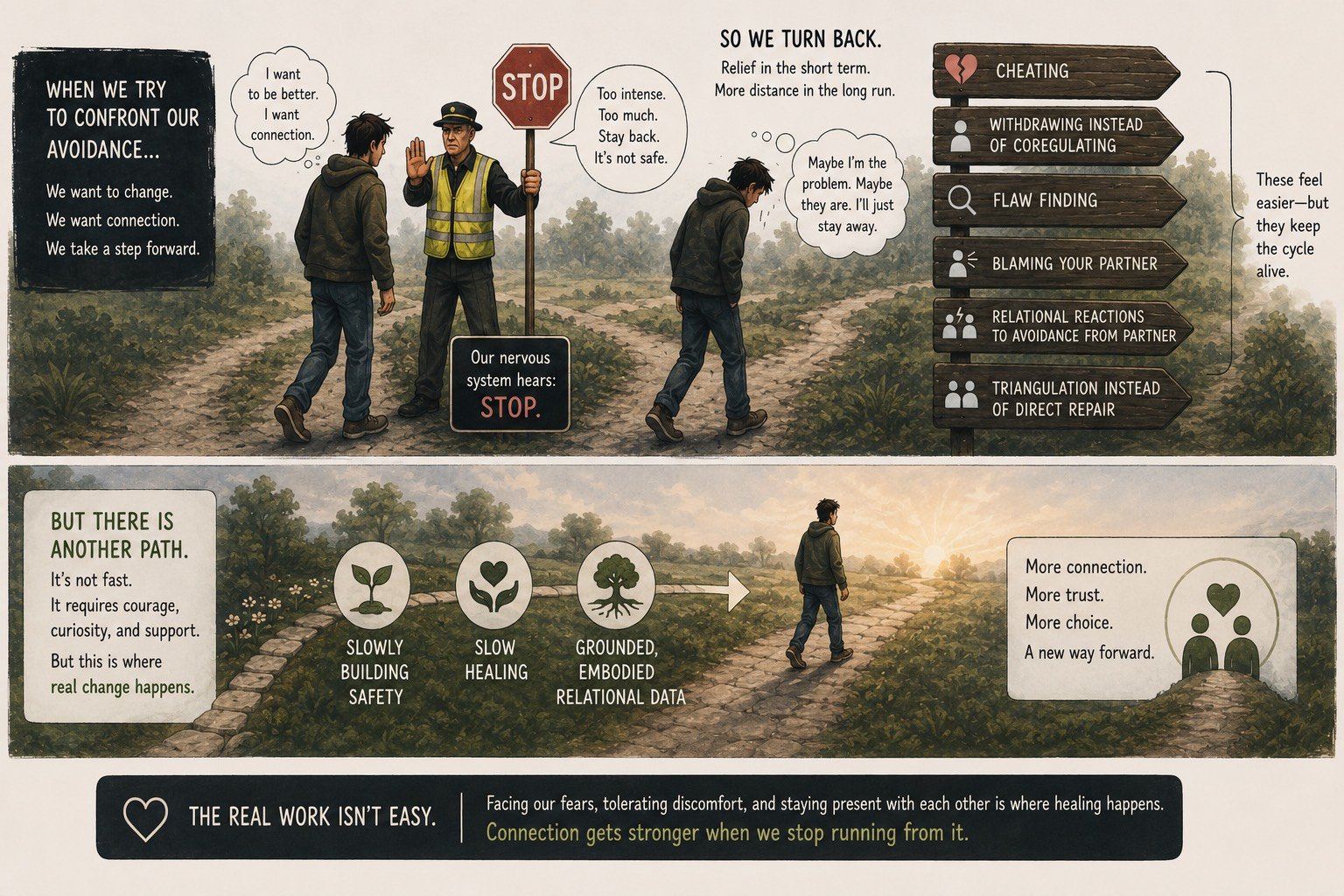
An image to help understand what avoidant fears feels like inside, and how this unresolved internal conflict influences choices
Imagine trying to cross the street toward someone you care about.
Just as you’re about to reach the other side, an angry crossing guard suddenly steps in front of you, waving a stop sign directly in your face.
The fear created by avoidance can feel overwhelming. Instead of tolerating that discomfort long enough to continue forward, many people understandably choose the path of least resistance. They turn around and walk back. Or these choose sideways paths like indirect, confusing communication, staying behind a screen, internal solo processing without grounded data, triangulation as reinforcement rather than directly facing the original person, or withdrawing to cope.
That momentary relief feels safer.
But unfortunately, avoiding the original fear often creates even larger problems.
Instead of battling only the initial fear, people begin battling shame, self-criticism, relationship conflict, and increasingly painful internal narratives.
Avoidance fuels the flames of shame.
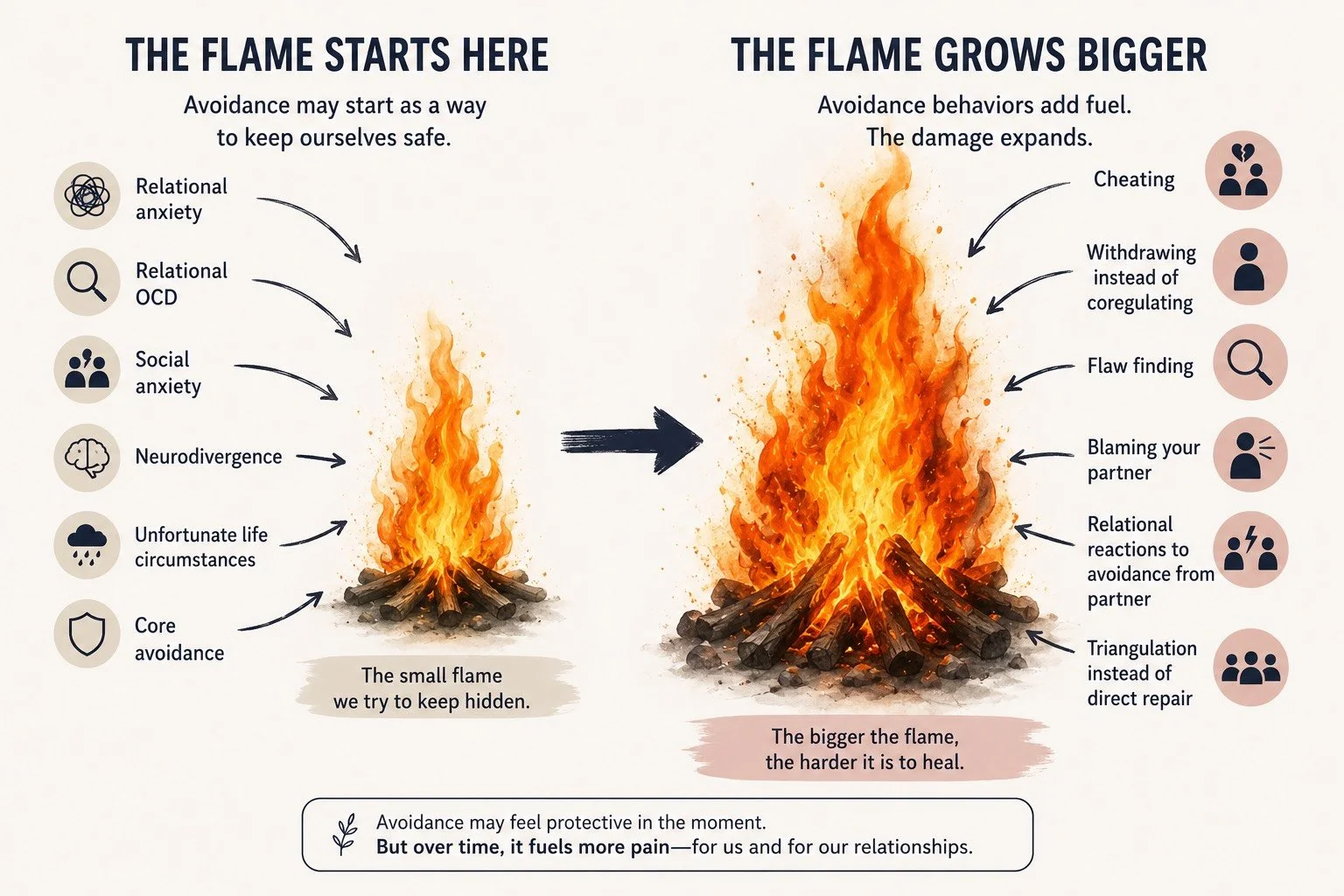
Minor ruptures become larger ruptures.
Partners react to the avoidance.
Those reactions create even more shame and distrust.
The nervous system becomes even more convinced that distance equals safety.
Over time the internal logic becomes:
“If I withdraw… dissociate… stay in fantasy… I can keep myself safe.”
Eventually people begin blaming the connection itself.
“This relationship feels too intense.”
“This person must be the problem.”
Rather than recognizing avoidance as the source of the distress, the nervous system concludes that distance is the solution.
Ironically, this reinforces the avoidance pattern, making genuine connection increasingly difficult while creating more pain for both people.
People naturally begin creating narratives to explain what happened.
When avoidance prevents authentic relational data from forming, partners are left trying to make sense of behaviors that never received repair.
Sometimes those narratives are accurate.
Sometimes they aren’t.
But without repair, people are forced to fill in the blanks.
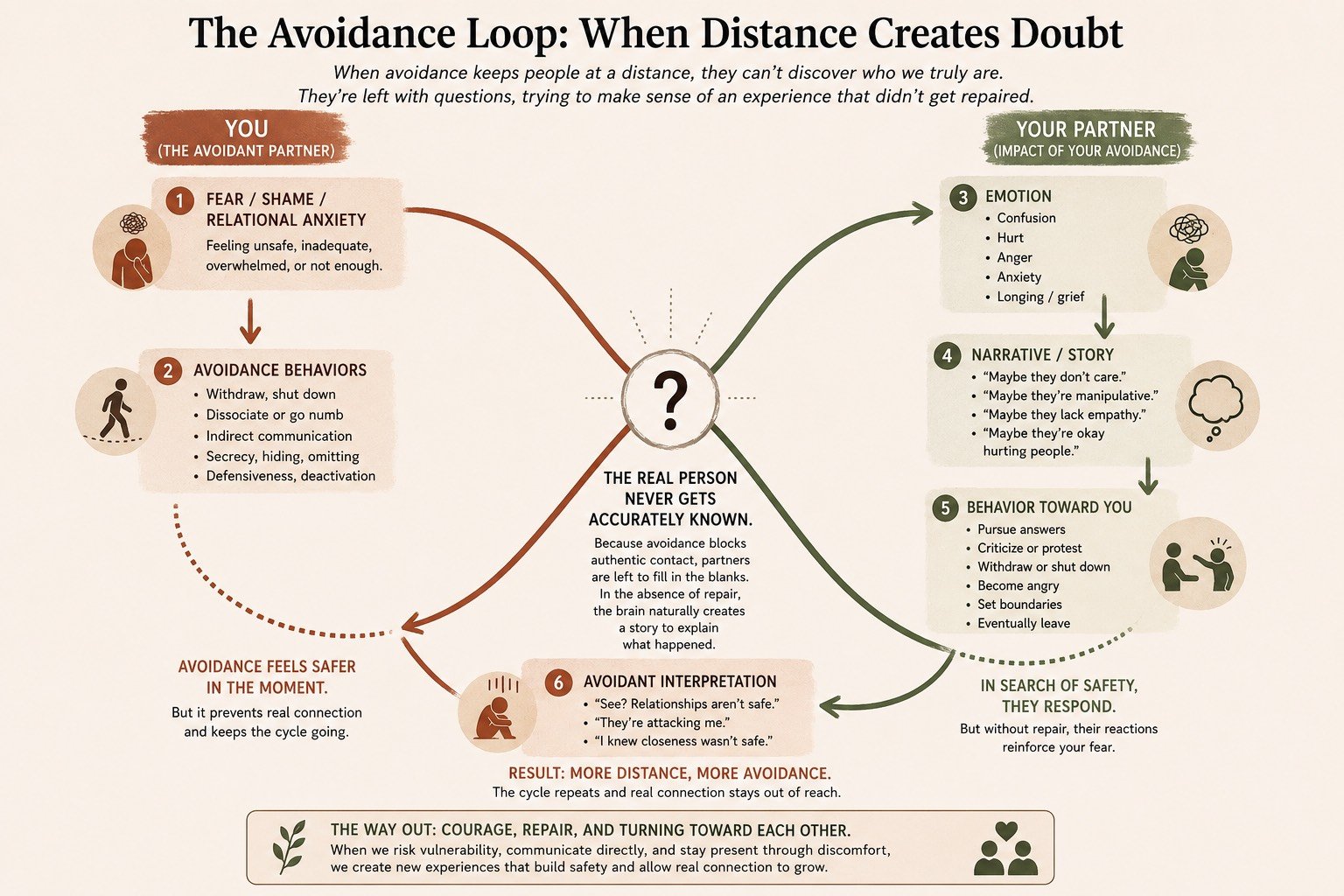
Notice something important happening here. The avoidant partner often struggles to fully turn toward the other person, even though their protective strategies may have a profound impact on the relationship. Notice how the arrows of avoidance repeatedly return to the self. Instead of curiosity about the other person’s experience, avoidant partners often subconsciously ask themselves “Am I safe? How do I reduce my discomfort? How do I escape shame? How do I stop feeling overwhelmed?”.
Meanwhile, the other partner’s attention often turns toward the avoidant person- trying to understand, reconnect, or make sense of what’s happening.
Even when the avoidant person is open enough to think about the other person, their organizing principle is often their own nervous system and the need to reduce internal distress. This is one reason avoidant protective strategies are sometimes mistaken for narcissism or selfishness. When someone repeatedly withdraws without explanation or repair, it creates an information vacuum that can be incredibly confusing for the other person.
Returning to the Original Question
Are We Incompatible, Is There a Values Mismatch, or Are Our Attachment Patterns Getting in the Way?
Lets return to answering the other part of one of the most common questions clients bring into therapy.
Sometimes a relationship reflects a genuine mismatch in values, goals, or the kind of relationship each person wants.
Sometimes a relationship is being shaped by different attachment patterns and protective strategies that keep each person stuck.
And sometimes, both are true.
In other situations, repeated unwillingness to repair, take accountability, or move toward connection may indeed reveal a deeper values difference. Clinically, it is often not possible to determine which is true without careful assessment and exploration. (Safety and answers in these complex situations cannot be found on our own or built through a screen, they require a skilled relational therapist in Philadelphia to assist. Read more about this below).
Differing attachment patterns can create real incompatibility if one or both partners aren’t willing to understand, take responsibility for, and work on those patterns.
Likewise, deeply held values can become a source of incompatibility when neither person is willing—or able—to move toward repair, accountability, or compromise.
The challenge is that these two things can sometimes look very similar on the surface.
A person acting from avoidance may appear emotionally unavailable, uncaring, dismissive, or unwilling to engage.
A person acting from deeply held values that conflict with yours may behave in very similar ways.
Part of the therapeutic process is slowing everything down enough to determine what is actually driving the behavior.
⸻
When a Values Mismatch May Exist
Here are some examples when a values mismatch may exist:
One partner may deeply believe that a colleague who violated HIPAA, acted unethically, and retraumatized a client could have chosen to turn toward connection and repair the situation from the beginning, rather than making choices that caused unnecessary pain and complications.
After more than a year of trying to help someone recognize that those choices were harmful—and that other options like direct repair, gathering in-person data, were available—they may conclude that this reflects a fundamental mismatch in values.
Or another partner may feel that someone doesn’t view triangulation the same way they do. They may believe their partner doesn’t understand that triangulation is often an avoidance behavior and doesn’t fully grasp the impossible, losing position their partner placed them in and them blamed them for their reactions in, and how this maladaptive protective strategy impacts an entire relational dynamic, and also calls character into question.
To many clients, if their partner doesn’t see how this is wrong, and instead decides to double down on poor judgment and defensiveness, this may reflect a values mismatch.
Or another person may feel that someone isn’t truly recognizing how emotionally immature, controlling, and psychologically unhealthy it can be for a former employer to compete for influence and positioning for a stranger over an employee they emotionally harmed, while no one ever questions, integrates, or challenges the nature of those behaviors.
To some clients, even considering choosing the path of betraying and harming someone as a viable option to “help yourself heal” also represents a values mismatch.
These examples are important because they are not minor disagreements.
They involve situations that can create significant relational trauma. And almost all unbiased professionals, even intern entry level clinicians, would recognize dynamics like these as extremely unprofessional, unethical, harmful, and overall giant red flags.
When clients perceive a fundamental difference in values surrounding accountability, ethics, repair, emotional maturity, or relational responsibility, many begin questioning whether the relationship is one they can continue investing in. Especially if no one has clarified through any repair conversation if the main issue is being fueled by a mismatch in character and values, or mostly avoidance.
⸻
Is the Missing Piece A Real, Direct Conversation, or is There a Values Mismatch?
Many clients come into therapy feeling completely exhausted.
They feel as though they’ve already tried everything.
But sometimes they’re missing one very important piece.
They haven’t yet tried turning toward embodied, off screen connection while working directly with a skilled therapist who truly understands attachment, trauma, relational dynamics, and the specific patterns keeping them stuck.
Unless there truly is a values mismatch—which sometimes is the case—many people who feel stuck simply haven’t yet explored every available option.
People with avoidance patterns often become so accustomed to solving problems on their own, creating distance, or relying on protective strategies that they don’t always recognize there may be another path available. It’s also possible in 2026, many people with avoidant tendencies confuse online “support” with real, embodied connection.
But sometimes the path involves slowing everything down.
Mapping the relationship from the very first rupture.
Understanding how one person’s protective strategies began influencing the other’s nervous system.
Identifying where misunderstandings started and then accumulated because they weren’t repaired.
Understanding that indirect communication cannot sustain a connection.
Separating avoidance from values.
Distinguishing attachment wounds from genuine incompatibility.
These involve working with a skilled therapist in Philadelphia to carefully map the trajectory of the relationship can help determine whether healing is possible—or whether the relationship truly reflects incompatible values.
⸻
The Goal Isn’t to Save Every Relationship
You don’t have to keep the people you care about at a distance.
But you also don’t have to stay in relationships that fundamentally conflict with your values.
And you shouldn’t have to protest for long periods of time to have someone understand that unprofessional, unethical, and certain values (or lack of them) that have caused harm are not acceptable.
You should feel safe enough to bring major concerns to your partner, friends, or colleagues, knowing that your relationship can survive when direct confrontation to challenging harm is needed. If you can’t bring concerns directly to a partner when there is harm and traumatization going on without being called “intense” for it, even when said calmly, then how is a relationship going to ever work?
Avoidance often causes challenges linking cause to effect, and understanding and facing consequences, so why then are there harmful behaviors that shouldn’t be going on in the first place if it’s hard to tolerate reactions that come from them? For example, if someone wants to avoid “intensity” or a protest response, maybe private material shouldn’t be put online in an unboundaried container, without consent, especially if someone has asked them to stop multiple times. These are genuine concerns that partners need to feel safe be addressed.
It’s true that avoidance sometimes prevents accurate relational data from ever forming.
When people repeatedly avoid repair, others are left trying to make sense of behaviors they never fully understood.
At the same time, it’s also true that sometimes there really is a genuine values mismatch.
Not every painful relationship can—or should—be repaired.
One of the goals of therapy is helping people distinguish between those possibilities.
A skilled therapist can help clients clarify their values.
They can help explore whether someone is consistently acting according to those values, whether avoidance is distorting their perceptions or behaviors, or whether a deeper incompatibility truly exists.
Without judgment, therapy with a skilled relational therapist in Philadelphia can help uncover the underlying motivations driving each person’s behavior, identify what is actually happening beneath the surface, and help people decide whether they want to move toward repair—or move forward separately.
Building safety, having repair conversations, and gaining real, embodied relational data requires taking action. If you’re ready to start taking action to getting collaborative answers rather than dealing with unresolved questions on your own, reach out to a skilled and compassionate relational therapist in Philly.
